
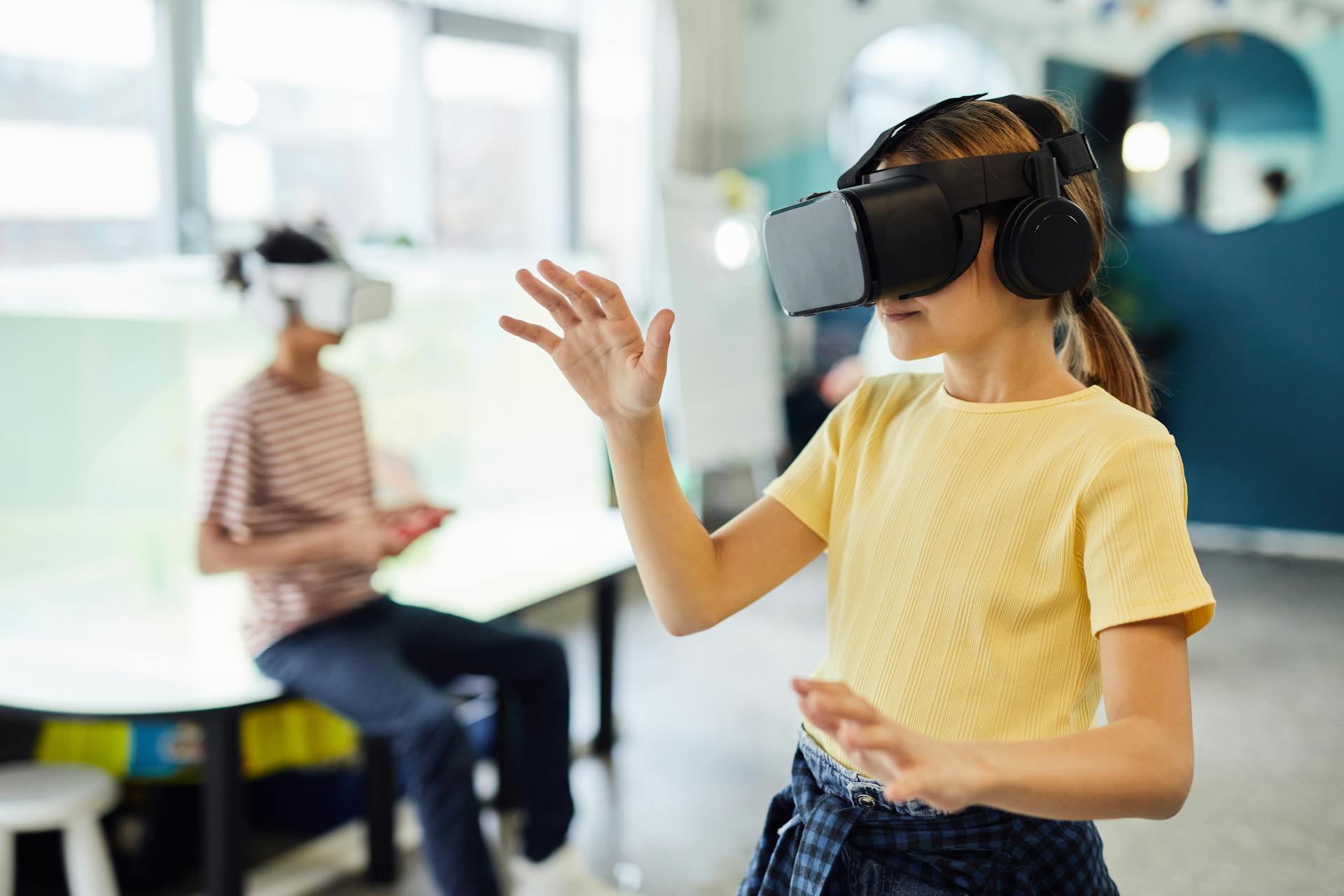
Imagine stepping into a classroom where the walls dissolve into a lush, prehistoric jungle, where you can walk among dinosaurs and witness their majestic roars in real-time. Or picture a scenario where students don virtual headsets to explore the surface of Mars, conducting experiments and gathering data as if they were actual astronauts. This is not the stuff of science fiction but a glimpse into the transformative potential of Virtual Reality (VR) in education.
Virtual Reality, a technology once confined to the realms of gaming and entertainment, has evolved dramatically over the past decade. Initially characterized by bulky headsets and rudimentary graphics, VR has now progressed to offer highly immersive and interactive experiences with sophisticated hardware and software. Today’s VR technology enables users to explore digital environments with unprecedented realism and engagement.
In the realm of education, VR is making waves by challenging and enhancing traditional learning methods. Its ability to provide immersive, hands-on experiences offers a revolutionary approach to teaching and learning. Schools and educational institutions are increasingly recognizing the value of VR, evidenced by a surge in investment and development of educational VR tools. This growing interest underscores a broader shift towards integrating cutting-edge technology into the classroom to enrich educational outcomes and engage students in novel ways.
As VR continues to advance, its potential to reshape education becomes more apparent, promising an exciting future where learning is more interactive, accessible, and impactful than ever before.
The Current State of VR in Education
Virtual Reality (VR) has made significant strides in education, offering a variety of tools and platforms that enhance traditional learning methods. Existing VR educational tools range from virtual field trips to interactive simulations. Virtual field trips provide students with the opportunity to explore historical sites, outer space, or underwater ecosystems, all from their classroom. These immersive experiences bring subjects to life, making them more engaging and memorable. Interactive simulations, on the other hand, allow students to experiment with scientific concepts or historical events in a virtual environment, offering a hands-on approach that traditional textbooks cannot match.
Several institutions have already realized the potential of VR in education, demonstrating its benefits through successful case studies. For instance, the University of Maryland has integrated VR into its medical training programs, enabling students to practice complex surgical procedures in a simulated environment. This approach not only enhances practical skills but also reduces the risk associated with hands-on training. Another notable example is the use of VR in engineering education at the Georgia Institute of Technology, where students interact with 3D models and simulations to better understand complex engineering systems. Feedback from these programs highlights improved student engagement, better retention of information, and a deeper understanding of complex concepts.
Future Trends and Innovations
As we look to the future, several trends and innovations are shaping the next phase of VR in education. VR technology continues to evolve with significant improvements in hardware, such as more comfortable headsets and enhanced haptic feedback systems that make virtual experiences feel more real. Software development is also evolving, with increasingly interactive and immersive content that provides richer educational experiences. The integration of VR with other emerging technologies, such as Artificial Intelligence (AI) and Augmented Reality (AR), opens up new possibilities. For example, AI could be used to create adaptive learning environments that adjust to each student’s learning style, while AR could overlay additional information onto the VR experience, providing a more comprehensive educational tool.
Benefits of VR in Education
The benefits of VR in education are manifold. It offers enhanced learning experiences through immersive and interactive environments that significantly improve student engagement and motivation. VR also promotes accessibility and inclusivity, providing opportunities for remote and underserved students to access quality education. Furthermore, VR supports skill development and practical training by allowing students to practice in a virtual setting, which is particularly valuable in fields such as medicine, engineering, and the arts.
Challenges and Considerations
Despite its potential, the implementation of VR in education faces several challenges. The cost of VR equipment and the financial burden on educational institutions are significant considerations. Additionally, creating high-quality, relevant VR content that aligns with educational standards requires collaboration and investment. Health and safety concerns related to prolonged use of VR headsets also need to be addressed to ensure safe and ergonomic learning environments.
The Role of Educators and Institutions
Educators and institutions play a crucial role in the successful integration of VR into curricula. Professional development for teachers is essential to equip them with the skills needed to use VR effectively in their teaching. Collaboration between educators and VR developers can help create content that meets educational goals. Institutions must also develop strategies for evaluating the impact of VR on learning outcomes and integrating VR experiences seamlessly into their curricula.
Conclusion
In conclusion, VR holds transformative potential for education, offering immersive, engaging, and accessible learning experiences. As technology continues to advance and adoption grows, VR is set to redefine teaching and learning. The long-term impact of VR in education will likely include more interactive and personalized learning experiences, making education more effective and inclusive for students worldwide.